


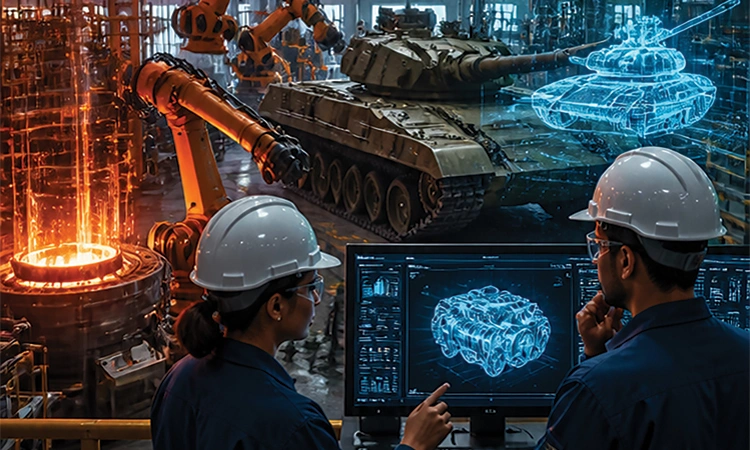
The rapid modernization of defence forces across the world has placed unprecedented emphasis on manufacturing technologies capable of producing lighter, stronger, and highly reliable components. In India, the push towards Aatmanirbhar Bharat and indigenous defence production has accelerated investments in advanced manufacturing capabilities, with metal forming emerging as one of the most critical enabling technologies. From aircraft structures and missile casings to armoured vehicles, naval systems and artillery components, advanced forming processes are helping manufacturers achieve superior quality, higher productivity and reduced material wastage.
The Need for Advanced Forming in Defence
Modern defence equipment demands components that can withstand extreme temperatures, high impact loads, corrosive environments and prolonged operational stress. Materials such as titanium alloys, high-strength steels, aluminium alloys, nickel-based superalloys and advanced composites have become increasingly common. However, these materials are often difficult to machine economically.
Advanced forming technologies provide an efficient alternative by enabling these materials to be shaped into complex geometries while maintaining their mechanical properties. This not only reduces manufacturing costs but also improves component performance and reliability.
Key Forming Technologies Driving Defence Manufacturing
Closed-Die Forging
Precision forging remains one of the most widely used forming processes in defence manufacturing. Components such as landing gear, turbine discs, gun barrels, connecting rods, shafts and structural fittings are commonly forged to achieve exceptional mechanical strength.
The directional grain flow produced during forging significantly improves fatigue life and impact resistance, making forged parts ideal for mission-critical applications.
Modern computer-controlled forging presses ensure repeatability, close dimensional tolerances and consistent metallurgical properties.
Isothermal and Hot Forging
Titanium and nickel alloys used in aerospace and missile applications require specialized forming methods because of their limited ductility at room temperature.
Isothermal forging, where both the die and workpiece are maintained at elevated temperatures, enables the production of complex parts with minimal residual stress and excellent microstructural control.
Hot forging similarly facilitates the forming of difficult-to-work materials while reducing forming loads.
Precision Sheet Metal Forming
Aircraft fuselage panels, helicopter components, missile skins and radar enclosures often involve intricate sheet metal parts.
Advanced sheet forming technologies such as hydroforming, stretch forming and superplastic forming enable manufacturers to produce lightweight components with exceptional dimensional accuracy and minimal weld joints.
Reducing the number of welded assemblies improves structural integrity while lowering overall component weight.
Hydroforming: Lightweight Yet Strong
Hydroforming has become increasingly popular in defence manufacturing because it uses high-pressure fluid to shape metal into complex configurations.
This process offers several advantages:
- Uniform wall thickness
- Improved surface finish
- Fewer assembly operations
- Reduced tooling requirements
- Higher structural rigidity Hydroformed parts are extensively used in aerospace structures, fuel systems, exhaust systems and vehicle chassis.
The ability to manufacture seamless hollow components makes hydroforming especially valuable for military vehicles and aircraft.
Roll Forming for Structural Components
Long structural members used in military shelters, transport vehicles and naval applications are frequently manufactured using roll forming.
Computer-controlled roll forming lines deliver consistent profiles with excellent dimensional accuracy while allowing high production speeds.
Modern servo-controlled roll forming equipment can accommodate high-strength steels and advanced alloys that were previously difficult to process.
Ring Rolling and Seamless Components
Large bearings, turbine rings, missile components and aerospace structures often require seamless rings possessing high structural integrity.
Ring rolling produces components with continuous grain flow, superior mechanical properties and minimal material wastage.
Compared to machining rings from solid billets, ring rolling significantly reduces both production costs and raw material consumption.
Incremental Sheet Forming
Prototype development plays an increasingly important role in defence research and development.
Incremental sheet forming enables manufacturers to produce low-volume, customized components without investing in expensive dedicated tooling.
This makes it particularly useful for defence laboratories, prototype weapon systems and specialized military equipment.
Digital Simulation Enhances Accuracy
One of the biggest advancements in modern forming technology is the use of finite element analysis (FEA) and digital simulation.
Engineers can now simulate material flow, stress distribution, die filling, spring-back behaviour and defect formation before physical production begins.
Digital twins of forming processes help optimize:
- Tool design
- Process parameters
- Material utilization
- Cycle times
- Product quality
Simulation significantly reduces costly trial-and-error development while accelerating production readiness.
Advanced Tooling Makes the Difference
High-performance dies and tooling are essential for defence-grade forming operations.
Today’s forming dies incorporate:
- High-speed tool steels
- Carbide inserts
- Advanced surface coatings
- Precision cooling channels
- Sensor-based monitoring
Smart tooling equipped with force, temperature and wear sensors enables predictive maintenance and consistent production quality.
Automation and Robotics
Automation is transforming defence manufacturing by improving productivity and process consistency.
Robotic handling systems safely transport hot forgings, while automated lubrication, die changing and inspection systems reduce downtime.
Integrated manufacturing cells combining forging presses, heat treatment, machining and inspection ensure complete traceability-a vital requirement for defence certification.
Artificial intelligence is increasingly being used to optimize forming parameters based on production data, minimizing defects and improving equipment utilization.
Quality Assurance is Paramount
Every defence component must comply with stringent quality standards.
Advanced inspection techniques include:
- Coordinate Measuring Machines (CMMs)
- Laser scanning
- Ultrasonic testing
- Eddy current inspection
- X-ray and computed tomography
- Digital metallography
Real-time process monitoring ensures that deviations are detected immediately, preventing defective components from entering critical defence assemblies.
For expensive aerospace-grade materials such as titanium, even small reductions in scrap generate significant economic benefits.
India’s Growing Opportunity
India’s defence manufacturing ecosystem is undergoing a major transformation through initiatives encouraging indigenous production, technology transfer and private-sector participation. Advanced forming capabilities are becoming increasingly important for manufacturers supplying components for fighter aircraft, helicopters, missiles, naval platforms, armoured vehicles and space-defence programmes.
Indian companies are investing in high-capacity forging presses, precision sheet forming equipment, automated production lines and digital manufacturing technologies to meet global quality standards. Collaboration between research institutions, MSMEs, defence public sector enterprises and private manufacturers is strengthening domestic capabilities while reducing dependence on imports.
Conclusion
Advanced metal forming has become a cornerstone of modern defence manufacturing, enabling the production of components that combine exceptional strength, precision and reliability with efficient material utilization. Whether through precision forging, hydroforming, superplastic forming, ring rolling or digitally optimized forming processes, manufacturers are meeting the increasingly demanding requirements of next-generation defence systems.
— P.K. Balasubramanian