


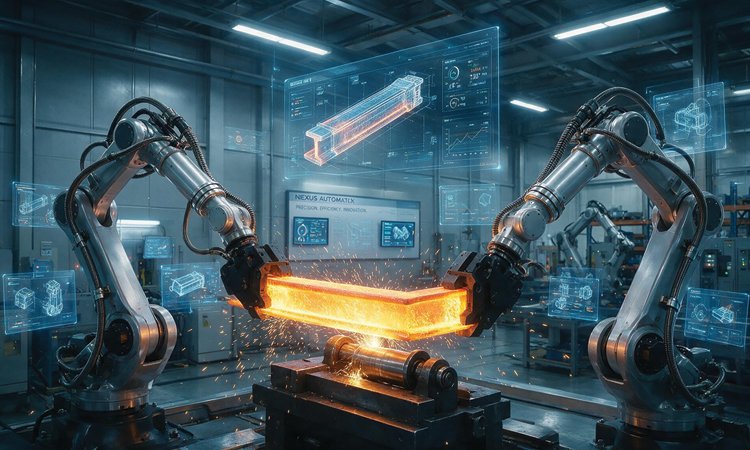
The metal forming industry is undergoing a digital transformation, and nowhere is this more evident than in modern press shops. Traditionally, press shop operations have relied heavily on operator expertise, trial-and-error adjustments and periodic maintenance to ensure consistent production. However, with increasing demands for higher productivity, tighter tolerances, shorter lead times and zero-defect manufacturing, conventional methods are no longer sufficient. Artificial Intelligence (AI) is emerging as a game-changing technology that is redefining press shop operations. By analysing vast amounts of production data in real time, AI enables manufacturers to optimise processes, predict equipment failures, improve product quality and reduce operational costs. Combined with Industry 4.0 technologies such as Industrial Internet of Things (IIoT), machine learning, computer vision and advanced analytics, AI is helping press shops become smarter, more efficient and highly adaptive.
The Changing Landscape of Press Shops
Modern press shops manufacture a wide variety of components for industries such as automotive, aerospace, railways, electrical equipment, appliances, construction, defence and renewable energy. These components often require extremely high dimensional accuracy, consistent surface quality and repeatable production.
Press shops face several operational challenges, including:
- Variations in material properties
- Die wear and unexpected tool failures
- Machine downtime
- Scrap generation
- Excessive energy consumption
- Lengthy die setup and changeover times
- Inconsistent product quality
AI addresses these challenges by continuously learning from production data and recommending or automatically implementing process improvements.
AI as the Brain of Smart Press Shops
Unlike conventional automation, which follows predefined rules, AI systems learn from historical and real-time data to identify hidden patterns and optimise production decisions.
Sensors installed on presses, dies and material handling systems continuously collect information such as:
- Press tonnage
- Ram speed
- Vibration levels
- Temperature
- Lubrication conditions
- Material thickness
- Cycle times
- Tool wear
- Power consumption
AI algorithms analyse this information instantly and identify deviations long before they become production problems. Optimising Press Parameters
Selecting the optimum press parameters has traditionally depended on operator experience.
AI now analyses thousands of production cycles to determine the ideal combinations of:
- Press speed
- Blank holder force
- Lubrication quantity
- Stroke length
- Cushion pressure
- Feed rate
The system automatically adjusts process parameters to suit variations in material batches, ensuring consistent forming quality.
This adaptive capability is particularly valuable when processing advanced high-strength steels, aluminium alloys and other difficult-to-form materials.
Intelligent Die Protection
Dies represent one of the most valuable assets in a press shop.
AI-enabled die protection systems combine sensor data with computer vision to monitor every production cycle.
The system can instantly detect:
- Misfeeds
- Double blanks
- Misalignment
- Slug accumulation
- Part sticking
- Excessive forming loads
The press automatically stops before serious die damage occurs.
Such intelligent monitoring dramatically extends die life while reducing repair costs.
Computer Vision Improves Quality Inspection
Manual inspection becomes increasingly difficult as production volumes rise.
AI-powered computer vision systems use high-resolution cameras and deep learning algorithms to inspect every component in real time.
The systems identify defects such as:
- Surface scratches
- Cracks
- Wrinkles
- Burrs
- Dimensional deviations
- Incomplete forming
- Edge defects
Unlike traditional inspection methods, AI continues learning from new defect patterns, steadily improving inspection accuracy while reducing false alarms.
This enables manufacturers to move closer to zero-defect production.
Reducing Scrap through AI
Scrap reduction directly improves profitability.
AI analyses correlations between material properties, lubrication, tooling conditions and machine settings to determine why defects occur.
Instead of reacting after defects appear, AI predicts the likelihood of scrap generation and recommends corrective actions before defective parts are produced.
Even a small reduction in scrap can generate substantial savings, especially when processing expensive materials such as stainless steel, aluminium, copper alloys or titanium.
Faster Die Setup and Changeovers
Frequent die changes reduce press utilisation.
AI helps optimise die setup by storing digital process recipes for every component.
When a repeat job is scheduled, the system automatically retrieves the optimum settings based on previous successful production runs.
Operators receive guided setup instructions, reducing adjustment time and ensuring consistent quality from the first production batch.
Combined with automated die-clamping systems and servo-controlled presses, AI significantly shortens changeover times.
Energy Optimisation
Press shops consume substantial amounts of electrical energy.
AI analyses energy consumption across machines, production schedules and operating conditions.
It identifies inefficient operating patterns and recommends improvements such as:
- Optimised press sequencing
- Reduced idle running
- Load balancing
- Efficient hydraulic pressure management
- Intelligent standby modes
These measures lower operating costs while supporting sustainability objectives.
AI and Digital Twins
Digital twin technology has become an important companion to AI.
A digital twin is a virtual representation of the physical press shop that continuously receives live production data.
AI analyses this virtual environment to simulate different production scenarios without interrupting actual manufacturing.
Manufacturers can evaluate:
- New die designs
- Alternative materials
- Different production schedules
- Process modifications
- Equipment upgrades
before implementing them on the shop floor.
This significantly reduces development costs and production risks.
India’s Opportunity in Smart Press Shops
India’s sheet metal and metal forming industry is rapidly embracing digital manufacturing as it caters to the automotive, electric vehicle, aerospace, defence, white goods and industrial equipment sectors. As manufacturers seek to enhance competitiveness and align with global quality standards, AI-driven process optimisation is becoming a strategic necessity rather than an optional upgrade.
Leading press shops are increasingly investing in sensor-enabled presses, servo press technology, cloud-based analytics, machine learning platforms and automated inspection systems. Government initiatives promoting smart manufacturing, digitalisation and advanced manufacturing are further encouraging the adoption of AI across the metal forming ecosystem. At the same time, domestic software developers, automation companies and machine builders are collaborating to create AI solutions tailored to Indian production environments, enabling even medium-sized enterprises to benefit from intelligent manufacturing.
Conclusion
Artificial Intelligence is transforming press shops from conventional production facilities into intelligent, data-driven manufacturing environments. By enabling predictive maintenance, adaptive process control, real-time quality inspection, energy optimisation and digital process simulation, AI significantly enhances productivity, reduces costs and improves product quality.
For manufacturers embracing Industry 4.0, AI-driven process optimisation is a strategic investment that delivers higher efficiency, greater reliability and world-class manufacturing performance. The press shops of the future will be intelligent, connected and capable of learning from every production cycle, setting new benchmarks in precision metal forming.