


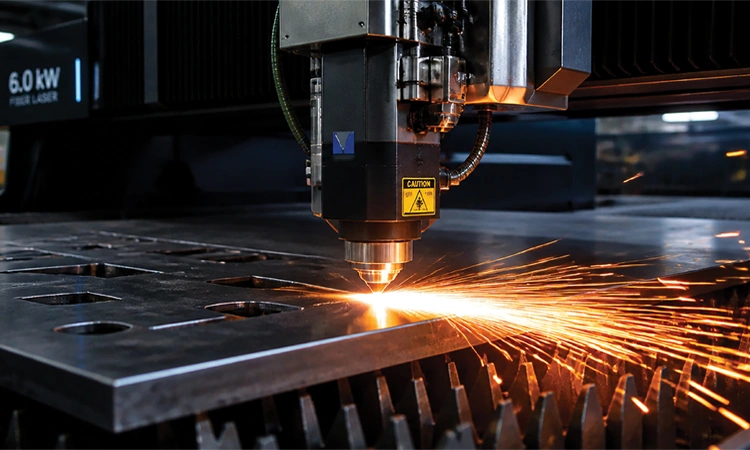
The sheet metal fabrication industry has witnessed remarkable technological advancements over the past two decades, with fiber laser technology emerging as one of the most transformative innovations. From automotive body panels and electrical enclosures to aerospace components, medical equipment and precision engineering parts, fiber lasers have revolutionized the way sheet metal is cut, processed and manufactured.
The Evolution of Laser Cutting
Laser cutting first gained industrial acceptance through CO₂ laser systems, which offered excellent cutting quality for a wide range of materials. However, CO₂ lasers required extensive maintenance, consumed significant electrical power and involved complex optical systems with mirrors and beam alignment.
Fiber laser technology has overcome many of these limitations. Instead of generating the laser beam through a gas-filled resonator, fiber lasers employ optical fibers doped with rare-earth elements such as ytterbium. The laser beam is generated and transmitted through flexible optical fibers directly to the cutting head, resulting in higher efficiency, greater reliability and lower maintenance requirements.
This technological shift has dramatically changed the economics and capabilities of sheet metal processing.
How Fiber Lasers Work
A fiber laser generates a highly concentrated beam of light within an optical fiber. The beam is amplified through stimulated emission and delivered to the cutting head through fiber-optic cables with minimal energy loss.
A precision focusing lens concentrates the laser beam into an extremely small spot, generating sufficient energy density to melt or vaporize the material. Assist gases such as nitrogen, oxygen or compressed air remove the molten metal from the cut, producing clean, accurate edges with minimal heat-affected zones.
The process is completely non-contact, eliminating mechanical stresses on the workpiece and reducing tool wear.
Superior Cutting Speed
One of the greatest advantages of fiber lasers is their exceptional cutting speed, particularly for thin and medium-thickness sheet metals.
Compared to conventional CO₂ lasers, fiber lasers can process mild steel, stainless steel, aluminium, brass and copper significantly faster while maintaining outstanding edge quality.
Higher cutting speeds enable manufacturers to:
- Increase production capacity
- Shorten lead times
- Improve machine utilization
- Reduce manufacturing costs
For high-volume industries such as automotive and appliance manufacturing, these productivity gains translate into substantial competitive advantages.
Exceptional Precision
Modern industries demand components with extremely tight dimensional tolerances.
Fiber lasers produce narrow kerf widths and highly accurate cuts, enabling the manufacture of intricate geometries that would be difficult or impossible using conventional cutting methods.
Their precision is particularly valuable for:
- Electrical enclosures
- Precision brackets
- Medical equipment
- Electronic components
- Aerospace structures
- EV battery components
Minimal dimensional variation also reduces downstream assembly problems.
Processing a Wide Range of Materials One of the defining strengths of fiber lasers is their versatility. They can efficiently process:
- Mild steel
- Stainless steel
- Aluminium alloys
- Copper
- Brass
- Galvanized steel
- Titanium
- Nickel alloys
- Advanced High-Strength Steels (AHSS)
Earlier laser technologies struggled to cut highly reflective materials such as copper and brass. Fiber lasers overcome this limitation through their shorter wavelength and superior beam absorption characteristics.
This capability has expanded their applications in electrical, electronics and renewable energy industries.
Improved Edge Quality
Fiber laser cutting produces clean, smooth edges with minimal burr formation.
The narrow heat-affected zone minimizes thermal distortion, reducing or eliminating secondary finishing operations.
Benefits include:
- Better dimensional accuracy
- Improved weldability
- Reduced grinding
- Lower finishing costs
- Higher product quality
Manufacturers often proceed directly from laser cutting to bending or welding without additional machining.
Automation and Lights-Out Manufacturing
Fiber lasers integrate seamlessly with automated manufacturing systems.
Modern laser cutting cells include:
- Automatic sheet loading
- Material storage towers
- Robotic unloading
- Part sorting
- Automated pallet exchange
- Intelligent production scheduling
These systems support unattended “lights-out” manufacturing, allowing production to continue around the clock with minimal operator intervention.
Automation not only improves productivity but also enhances workplace safety by reducing manual material handling.
Smart Software and Nesting Optimization
Today’s fiber laser systems are driven by sophisticated CAD/CAM software.
Advanced nesting algorithms automatically arrange components on the sheet to maximize material utilization while minimizing scrap.
- Software also optimizes:
- Cutting sequence
- Piercing locations
- Tool paths
- Gas consumption
- Machine movements
Artificial intelligence and machine learning are increasingly being incorporated to optimize cutting parameters based on material type, thickness and production history.
The result is improved efficiency with reduced operating costs.
Fiber lasers are significantly more energy-efficient than earlier laser technologies.
Electrical-to-optical conversion efficiencies often exceed 40%, substantially reducing power consumption compared to CO₂ laser systems.
Flexible Manufacturing
Modern manufacturing increasingly requires small batch production and rapid product changes.
Unlike dedicated punching tools or mechanical dies, fiber lasers require no physical tooling.
Changing from one component to another simply involves loading a new program.
This flexibility makes fiber lasers ideal for:
- Prototype development
- Customized production
- Job shops
- Short production runs
- High-mix manufacturing
Manufacturers can respond quickly to changing customer requirements without expensive tooling investments.
Supporting Downstream Processes
Fiber laser cutting integrates seamlessly with other fabrication operations.
Laser-cut components proceed efficiently to:
- CNC press brakes
- Robotic welding
- Automated assembly
- Powder coating
- Precision machining
Because dimensional accuracy remains highly consistent, downstream operations require fewer adjustments and less rework.
This improves overall manufacturing productivity.
Expanding Industrial Applications
Fiber laser technology has broadened its reach well beyond conventional fabrication.
Today, it supports manufacturing in:
Automotive: Body panels, chassis components, exhaust systems and EV battery enclosures.
Aerospace: Precision structural components, brackets and lightweight assemblies.
Electrical & Electronics: Control panels, switchgear, busbars and precision enclosures.
Medical Devices: Surgical instruments, implant components and diagnostic equipment.
Railways: Coach structures, HVAC systems and interior panels.
Renewable Energy: Solar panel structures, battery systems and wind turbine components.
Defence: Armour components, communication systems and precision fabricated assemblies.
India’s Growing Fiber Laser Ecosystem
India has witnessed rapid adoption of fiber laser technology as manufacturers modernize their fabrication facilities to meet global quality and productivity standards. The growth of the automotive, electric vehicle, aerospace, defence, electronics and renewable energy sectors has accelerated investments in high-power fiber laser cutting systems, automated material handling and digital manufacturing solutions.
Small and medium enterprises (SMEs) are also embracing fiber lasers, attracted by their flexibility, lower operating costs and ability to serve diverse customer requirements. As export opportunities expand, fiber laser technology is enabling Indian fabricators to produce high-quality components that meet the stringent standards of international markets.
Future Trends
The future of fiber laser technology lies in greater intelligence and automation. Artificial Intelligence (AI) will optimize cutting parameters in real time, while machine vision systems will monitor cut quality and automatically compensate for process variations. Higher-power lasers, adaptive beam shaping and integrated robotic fabrication cells will further enhance productivity and broaden the range of materials and thicknesses that can be processed efficiently.
Conclusion
Fiber laser technology has fundamentally transformed sheet metal processing by delivering unprecedented levels of speed, precision, flexibility and energy efficiency. Its ability to process a wide range of materials with exceptional quality while supporting automation and smart manufacturing has made it the preferred cutting technology across numerous industries.