


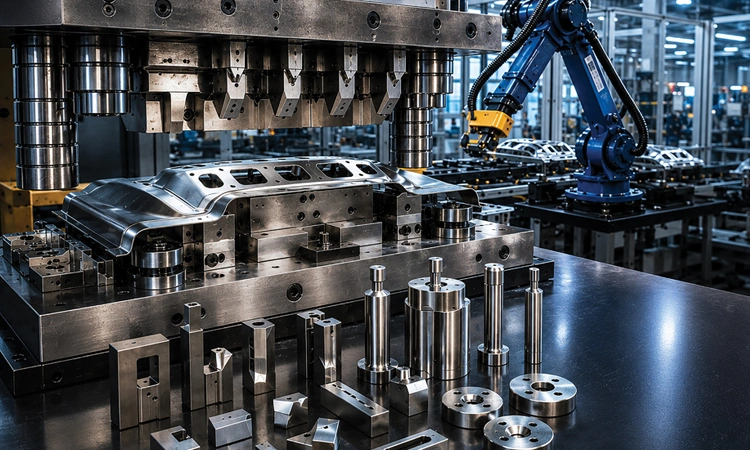
Sheet metal forming is one of the most widely used manufacturing processes across industries such as automotive, aerospace, electrical equipment, consumer appliances, railways, defence and industrial machinery. As manufacturers strive to achieve higher production speeds, tighter tolerances and longer tool life, tooling materials have become a decisive factor in process efficiency. Among the various materials used for dies and punches, cemented carbide tooling has emerged as a preferred choice for demanding sheet metal forming applications due to its exceptional hardness, wear resistance and dimensional stability. Although tool steels continue to be widely used for general-purpose forming operations, carbide tooling is increasingly being adopted where high production volumes, difficult-to-form materials and stringent quality requirements demand superior performance. Its ability to withstand extreme operating conditions while maintaining precision has made carbide tooling indispensable in modern press shops.
Understanding Carbide Tooling
Carbide tooling is primarily manufactured from cemented carbide, a composite material consisting of tungsten carbide (WC) particles bonded together with a metallic binder, usually cobalt. This combination results in a material that is significantly harder than conventional tool steels while retaining sufficient toughness for industrial applications.
The proportion of tungsten carbide and cobalt can be varied to suit specific applications. Grades with higher cobalt content provide greater toughness for impact-resistant applications, while those with higher carbide content offer superior wear resistance for continuous production.
Besides tungsten carbide, special grades may incorporate titanium carbide, tantalum carbide or niobium carbide to further enhance performance under specific operating conditions.
Why Carbide for Sheet Metal Forming?
Sheet metal forming tools are subjected to repeated compressive loads, friction, abrasion and impact during every press cycle. Over time, conventional tooling materials experience wear that leads to dimensional inaccuracies, burr formation and deteriorating part quality.
Carbide tooling addresses these challenges through several inherent advantages.
Exceptional Wear Resistance
One of carbide’s greatest strengths is its remarkable resistance to abrasive wear. Whether forming mild steel, stainless steel or advanced high-strength steels (AHSS), carbide tools retain their cutting edges and forming profiles for significantly longer periods than conventional tool steel.
This translates into:
- Longer production runs
- Reduced maintenance
- Consistent part quality
- Lower tooling costs over the product lifecycle
For high-volume automotive production, these benefits can substantially improve manufacturing efficiency.
Superior Hardness
Tungsten carbide possesses hardness levels approaching that of diamond. This enables punches and dies to resist deformation even under extremely high forming pressures.
Maintaining dimensional accuracy throughout long production cycles is especially important in precision components used for electric vehicles, electronics and aerospace assemblies.
Improved Surface Finish
Smooth, wear-resistant carbide tool surfaces reduce friction between the tool and the workpiece.
The benefits include:
- Better surface finish
- Reduced galling
- Lower risk of scratches
- Improved dimensional consistency
- Enhanced appearance of finished parts
These advantages are particularly valuable when forming stainless steel, aluminium and coated sheet materials.
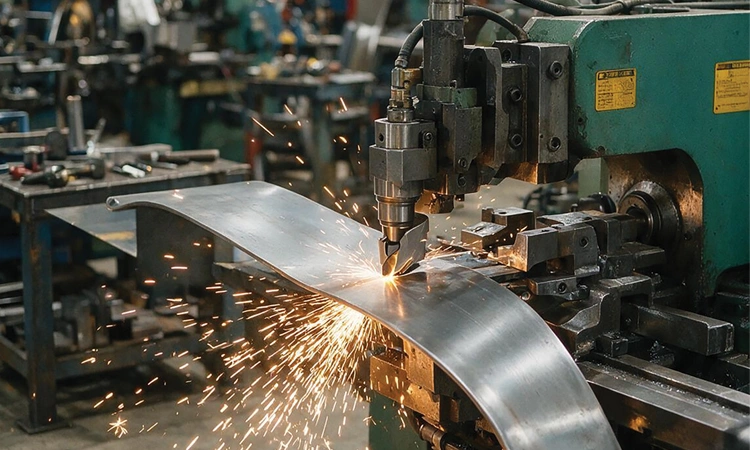
Applications in Sheet Metal Forming
Carbide tooling is used across a wide range of press shop operations.
Blanking
Blanking operations require sharp cutting edges capable of producing clean sheared surfaces.
Carbide punches and dies maintain edge sharpness over millions of production cycles, minimizing burr formation and reducing the need for frequent regrinding.
Piercing
Small holes in electrical laminations, connectors and precision components demand extremely accurate punches.
Carbide punches resist wear and breakage while maintaining consistent hole dimensions.
Fine Blanking
Fine blanking requires exceptional dimensional precision and burr-free edges.
Carbide tooling enables manufacturers to produce near-machined quality components directly from sheet metal, reducing secondary machining operations.
Progressive Dies
Progressive dies perform multiple operations in a single press stroke.
Since these tools operate continuously under high production rates, carbide inserts significantly extend die life and reduce production interruptions.
Forming and Bending
Carbide inserts are frequently incorporated into forming dies for bending, embossing and coining applications where localized wear is severe.
Instead of manufacturing the complete die from carbide, only critical wear areas are fitted with carbide inserts, offering an economical solution.
Processing Advanced Materials
Modern industries increasingly utilize:
- Advanced High-Strength Steels (AHSS)
- Ultra High-Strength Steels (UHSS)
- Stainless steels
- Electrical steels
- Aluminium alloys
- Copper alloys
- Titanium sheets
These materials are considerably harder to form than conventional steels and accelerate tool wear.
Carbide tooling withstands these demanding materials far better than traditional tool steels, making it the preferred choice for manufacturers supplying components to the automotive, aerospace and defence sectors.
Precision Through Dimensional Stability
One of carbide’s major advantages is its ability to maintain dimensional accuracy throughout extended production runs.
Unlike softer tooling materials, carbide experiences minimal wear, ensuring:
- Stable clearances
- Consistent hole sizes
- Accurate bends
- Uniform blank dimensions
This reduces process variation and improves overall quality control.
Reducing Downtime
Frequent tool maintenance results in lost production time.
Because carbide tooling requires fewer sharpening and replacement cycles, manufacturers benefit from:
- Higher machine availability
- Increased production output
- Lower maintenance costs
- Reduced inventory of spare tools
The result is improved Overall Equipment Effectiveness (OEE).
Coatings Further Enhance Performance
Modern carbide tooling is often combined with advanced Physical Vapour Deposition (PVD) or Chemical Vapour Deposition (CVD) coatings.
Popular coatings include:
- Titanium Nitride (TiN)
- Titanium Carbonitride (TiCN)
- Titanium Aluminium Nitride (TiAlN)
- Chromium Nitride (CrN)
- Diamond-Like Carbon (DLC)
These coatings further reduce friction, improve wear resistance and enhance corrosion protection, particularly when forming coated or abrasive materials.
Supporting Automation and Smart Manufacturing
Modern press shops increasingly incorporate automation, robotics and digital process monitoring. Carbide tooling complements these technologies by delivering predictable performance over long production runs, reducing unexpected stoppages and supporting unattended operation.
Sensor-equipped tooling systems can monitor wear, temperature and forming loads, allowing predictive maintenance before problems occur. Combined with AI-driven analytics, carbide tooling contributes to consistent production quality and optimized process control in Industry 4.0 environments.
Conclusion
Carbide tooling has become a cornerstone of modern sheet metal forming, offering unmatched wear resistance, dimensional accuracy and production reliability. Its ability to withstand high forming loads, process advanced materials and maintain precision over extended production runs makes it an invaluable asset for high-volume manufacturing. As manufacturing demands grow ever more exacting, carbide tooling will continue to provide the durability, precision and efficiency needed to shape the future of sheet metal forming.