




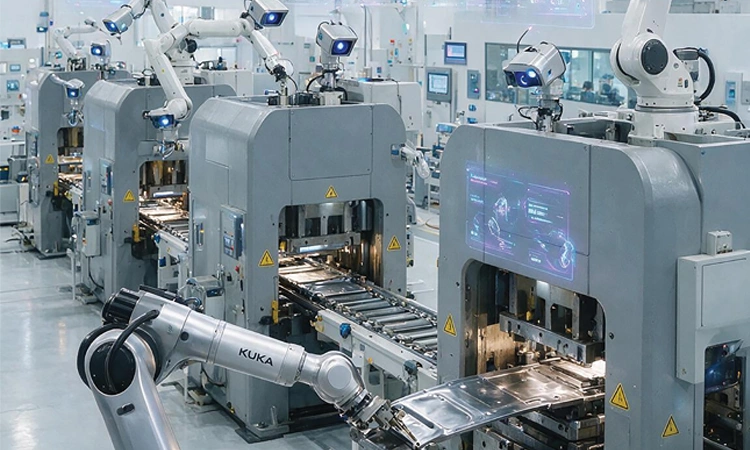
The evolution of manufacturing towards Industry 4.0 has transformed press shops from labour-intensive production facilities into highly automated, intelligent manufacturing environments. Among the most significant developments in this transformation is the widespread adoption of robotic loading and unloading systems in press lines. As manufacturers face increasing demands for higher productivity, consistent quality, shorter production cycles and improved workplace safety, industrial robots have become indispensable partners in sheet metal forming operations.
The Growing Need for Automation
Modern press shops are expected to deliver high-volume production while maintaining stringent quality standards. Components are becoming increasingly complex, production batches are becoming smaller and customer expectations continue to rise.
At the same time, manufacturers face challenges such as:
- Labour shortages
- Rising labour costs
- Demand for faster production
- Zero-defect manufacturing
- Workplace safety regulations
- Frequent product changeovers
Robotic automation addresses these challenges by ensuring consistent material handling with minimal human intervention.
Robotic loading systems automatically pick sheet blanks from storage stacks or conveyors and accurately position them inside the press.
After the forming operation is completed, unloading robots remove the finished components and place them onto conveyors, pallets or secondary processing stations.
Depending on production requirements, robotic systems may include:
- Six-axis articulated robots
- Cartesian robots
- Gantry robots
- Collaborative robots (cobots)
- Vision-guided robotic systems
These robots operate in perfect synchronization with presses, feeders and transfer systems to create highly efficient production cells.
Improved Productivity
One of the primary advantages of robotic automation is significantly higher production output.
Unlike manual operators, robots perform repetitive loading and unloading operations continuously without fatigue.
Benefits include:
- Faster cycle times
- Consistent production rates
- Reduced idle time
- Improved machine utilization
- Higher Overall Equipment Effectiveness (OEE)
Modern robotic systems can achieve precise movements within fractions of a second, allowing presses to operate at their maximum designed capacity.
Exceptional Repeatability
In sheet metal forming, even slight variations in blank positioning can lead to dimensional inaccuracies, wrinkles or die damage.
Industrial robots provide positioning accuracy within fractions of a millimetre, ensuring that every blank is placed exactly where required.
This consistency improves:
- Forming accuracy
- Part quality
- Tool life
- Process stability
- Assembly performance
Repeatable handling is particularly valuable when processing thin sheets or complex geometries.
Enhanced Workplace Safety
Press shops involve heavy machinery, high forming forces and moving components that present potential safety risks.
Robotic loading eliminates the need for operators to place their hands near the press during production.
Workers are instead assigned to higher-value activities such as:
- Process monitoring
- Quality inspection
- Production planning
- Preventive maintenance
- Robot programming
Reducing manual interaction with operating presses significantly lowers the risk of workplace injuries while improving compliance with occupational safety standards.
Handling Complex Components
Modern formed components often possess intricate shapes and delicate surfaces.
Robotic end-of-arm tooling equipped with vacuum cups, magnetic grippers or adaptive mechanical grippers handles these components gently while preventing scratches, dents or deformation.
Advanced gripping systems automatically adjust to accommodate different component sizes and geometries.
This flexibility supports manufacturers producing multiple product variants on the same production line.
Integration with Servo Presses
Servo presses have introduced programmable slide motion, enabling more sophisticated forming operations.
Robotic handling systems integrate seamlessly with servo presses by synchronizing blank loading and part removal with variable ram speeds and dwell times.
This coordination improves overall process efficiency while maximizing the benefits of servo-controlled forming.
Machine Vision Enhances Accuracy
Modern robotic systems increasingly incorporate machine vision technologies.
Vision systems verify:
- Blank orientation
- Material dimensions
- Position accuracy
- Surface condition
- Double-sheet detection
The robot automatically corrects positioning errors before loading the press.
This prevents costly die damage while ensuring consistent product quality.
Vision-guided robotics is particularly valuable when processing coated materials, aluminium sheets and complex-shaped blanks.
Intelligent End-of-Arm Tooling
The effectiveness of robotic handling largely depends on end-of-arm tooling (EOAT).
- Modern EOAT systems include:
- Vacuum suction systems
- Electromagnetic grippers
- Pneumatic grippers
- Adaptive gripping mechanisms
- Sensor-equipped tooling
Integrated sensors monitor gripping force, vacuum pressure and component presence, ensuring reliable handling throughout production.
Quick-change tooling further enables rapid product changeovers.
Automation Beyond Loading and Unloading
Today’s robotic press lines extend automation throughout the production process.
Robots may also perform:
- Blank destacking
- Lubrication
- In-process inspection
- Part orientation
- Stacking and palletizing
- Bin sorting
- Feeding secondary operations
Entire press shops now operate as fully integrated manufacturing cells where robots communicate with conveyors, presses, inspection equipment and manufacturing execution systems.
Supporting Flexible Manufacturing
Manufacturers increasingly produce multiple product variants in smaller batch sizes.
Robotic automation enables rapid changeovers through programmable motion sequences rather than mechanical adjustments.
When production changes, operators simply select a new program instead of physically modifying transfer mechanisms.
This flexibility significantly reduces setup times while supporting just-in-time manufacturing.
Human-Robot Collaboration
Rather than replacing workers, robotic automation is changing the nature of manufacturing jobs.
Operators increasingly serve as:
- Robot supervisors
- Process engineers
- Automation technicians
- Quality specialists
- Maintenance experts
Collaborative robots, or cobots, are also entering certain press shop applications. Equipped with advanced force sensors and safety systems, cobots can work alongside human operators on lower-speed or auxiliary tasks such as part inspection, light assembly or packaging, reducing physical strain while improving workflow.
The demand for skilled personnel capable of programming, maintaining and optimizing robotic systems continues to grow, creating new career opportunities in advanced manufacturing.
India’s Advancing Robotic Press Shops
India’s manufacturing sector is rapidly embracing robotic automation as automotive, electric vehicle, appliance, electronics and defence production continues to expand. Leading manufacturers are investing in automated press lines equipped with robotic loading and unloading, vision-guided handling, servo presses and digital monitoring systems to achieve global standards of productivity and quality.
The next generation of robotic press lines will be characterized by greater intelligence, connectivity and autonomy. AI-enabled robots will adapt automatically to variations in material properties, optimize handling sequences in real time and coordinate seamlessly with digital twins, manufacturing execution systems (MES) and enterprise resource planning (ERP) platforms. Remote diagnostics, cloud connectivity and predictive maintenance will further enhance equipment availability and operational efficiency.
Conclusion
Robotic loading and unloading systems have fundamentally transformed press line operations by delivering higher productivity, exceptional precision, improved safety and greater manufacturing flexibility. Their ability to perform repetitive material handling tasks with speed and consistency enables manufacturers to maximize press utilization while maintaining superior product quality.
When integrated with servo presses, machine vision, artificial intelligence and Industry 4.0 technologies, robotic automation becomes a strategic driver of manufacturing excellence rather than simply a labour-saving tool. For India’s growing metal forming industry, continued investment in robotic press line automation will strengthen global competitiveness, improve workplace safety and support the production of increasingly sophisticated components.