


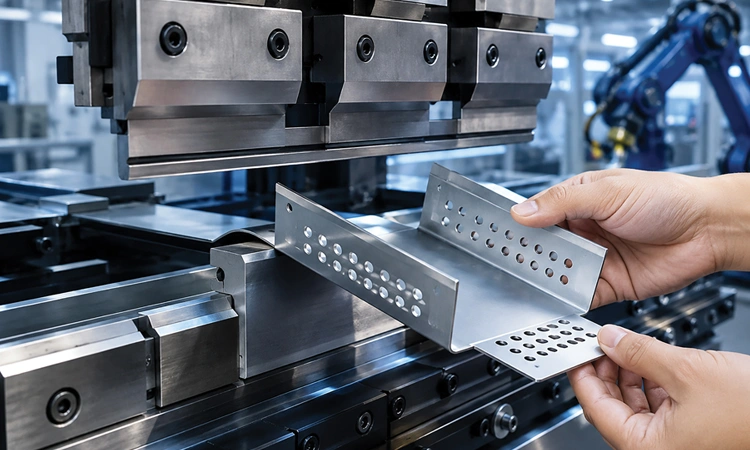
The global manufacturing landscape is increasingly focused on producing components that are lighter, stronger and more efficient without compromising structural integrity or performance. Industries such as automotive, aerospace, defence, electric vehicles (EVs), railways, consumer electronics and renewable energy are continually seeking innovative ways to reduce weight while improving durability and sustainability. At the heart of this transformation lies precision sheet metal forming, a manufacturing technology that enables the production of complex, lightweight components with exceptional dimensional accuracy and repeatability.
Why Lightweight Components Matter
Reducing component weight has become a major design objective across industries. In the automotive sector, every kilogram saved contributes to improved fuel efficiency and lower emissions. For electric vehicles, lighter body structures increase battery range and overall vehicle performance. In aerospace, weight reduction directly lowers fuel consumption and enhances payload capacity, while in defence and railway applications, lightweight structures improve mobility, operational efficiency and energy savings.
The Fundamentals of Precision Sheet Metal Forming
Sheet metal forming encompasses a variety of manufacturing processes in which flat metal sheets are transformed into three-dimensional components through plastic deformation. Unlike machining, where material is removed, forming reshapes the material while maintaining its continuity.
Precision forming employs accurately designed tooling, computer-controlled presses and optimized process parameters to achieve close tolerances and consistent quality. The process is particularly suitable for high-volume production where repeatability is essential.
Materials commonly processed include:
- Mild steel
- Stainless steel
- Aluminium alloys
- Copper alloys
- Brass
- Titanium alloys
- Advanced High-Strength Steels (AHSS)
- Ultra High-Strength Steels (UHSS)
These materials are widely used in structural, functional and decorative applications across multiple industries.
Advanced Forming Processes
Modern manufacturing utilizes a range of precision sheet metal forming techniques depending on component geometry and production requirements.
Precision Stamping
Precision stamping remains one of the most widely used sheet metal forming processes. Progressive dies perform multiple operations-including blanking, piercing, bending and forming-in a single press cycle.
This process offers high production rates, excellent repeatability and minimal labour intervention, making it ideal for automotive body panels, electrical components and appliance parts.
Deep Drawing
Deep drawing transforms flat blanks into seamless hollow components such as fuel tanks, battery enclosures, kitchen sinks and cylindrical housings.
Advanced deep drawing techniques enable manufacturers to produce complex shapes with minimal thinning while maintaining dimensional accuracy.
Hydroforming
Hydroforming uses high-pressure hydraulic fluid instead of rigid punches to shape metal sheets.
The process offers several advantages:
- Uniform wall thickness
- Reduced springback
- Superior surface finish
- Fewer weld joints
- Greater design flexibility
Hydroforming is extensively used for aerospace panels, automotive structural parts and EV battery trays where lightweight construction is critical.
Stretch Forming
Stretch forming is commonly employed for producing large curved panels used in aircraft fuselages, railway coaches and architectural structures.
Controlled stretching minimizes wrinkling while ensuring accurate contour formation.
Roll Forming
Roll forming produces continuous profiles such as rails, channels and structural members by gradually bending sheet metal through successive roller stations.
The process offers excellent dimensional consistency and high productivity for long components.
The Role of High-Strength Materials
The demand for lightweight structures has accelerated the use of Advanced High-Strength Steels (AHSS), aluminium alloys and titanium. These materials offer superior strength-to-weight ratios but are significantly more challenging to form than conventional steels.
Precision sheet metal forming addresses these challenges through:
- Servo-controlled presses
- Optimized lubrication systems
- Precision die design
- Controlled forming speeds
- Advanced forming simulations
These technologies help prevent cracking, wrinkling and excessive springback while maintaining product quality.
Digital Simulation Improves Accuracy
One of the biggest advancements in precision sheet metal forming is the use of digital engineering tools.
Finite Element Analysis (FEA) allows engineers to simulate material flow, deformation, stress distribution and springback before actual production begins.
Simulation enables manufacturers to:
- Optimize die geometry
- Predict forming defects
- Improve material utilization
- Reduce development time
- Minimize costly trial-and-error
Digital twins further enhance production by continuously comparing actual manufacturing data with virtual models, enabling continuous process optimization.
Smart Tooling and Servo Presses
Modern precision forming depends heavily on advanced tooling technologies.
Today’s forming dies incorporate:
- High-performance tool steels
- Carbide inserts
- Wear-resistant coatings
- Precision guide systems
- Integrated cooling channels
Servo presses have further revolutionized sheet metal forming by providing programmable ram motion.
Unlike conventional mechanical presses, servo presses allow precise control over:
- Slide velocity
- Stroke profile
- Dwell time
- Forming force
This flexibility improves forming quality while extending die life and reducing energy consumption.
Automation Enhances Productivity
Automation has become indispensable in precision sheet metal forming.
Industrial robots now perform:
- Blank loading
- Component transfer
- Part unloading
- Quality inspection
- Palletizing
Automated material handling minimizes manual intervention, reduces damage to finished components and significantly improves production consistency.
Vision systems and AI-powered inspection further ensure that every component meets stringent quality standards.
Quality Assurance
Lightweight components often serve critical structural functions where dimensional accuracy is essential.
Modern quality assurance involves:
- Coordinate Measuring Machines (CMMs)
- Laser scanning
- Optical measurement systems
- 3D vision inspection
- Surface roughness testing
- Digital process monitoring
Real-time process monitoring enables immediate corrective action, reducing scrap and improving overall equipment effectiveness.
Applications Across Industries
Precision sheet metal forming supports a broad range of industries:
Automotive: Body panels, chassis components, battery enclosures, structural reinforcements and crash management systems.
Electric Vehicles: Battery housings, motor covers, lightweight frames, cooling systems and power electronics enclosures.
Aerospace: Aircraft skins, fuselage panels, wing structures and engine components.
Defence: Armoured vehicle panels, missile casings, radar enclosures and structural assemblies.
Railways: Coach structures, interior panels and lightweight support members.
Electronics: Precision enclosures, heat sinks and shielding components.Renewable
Energy: Solar mounting systems, wind turbine components and electrical cabinets.
India’s Growing Potential
India is steadily strengthening its capabilities in precision sheet metal forming, supported by growth in the automotive, electric vehicle, aerospace, defence and electronics sectors. Increasing investments in advanced press shops, servo presses, laser blanking systems and automated production lines are enabling manufacturers to produce world-class lightweight components for both domestic and export markets.
Conclusion
Precision sheet metal forming has become a cornerstone of modern lightweight manufacturing, enabling industries to produce components that combine reduced weight with exceptional strength, accuracy and reliability. By leveraging advanced forming processes, intelligent tooling, servo press technology, digital simulation and automation, manufacturers can meet increasingly demanding performance and quality standards while improving productivity and sustainability.